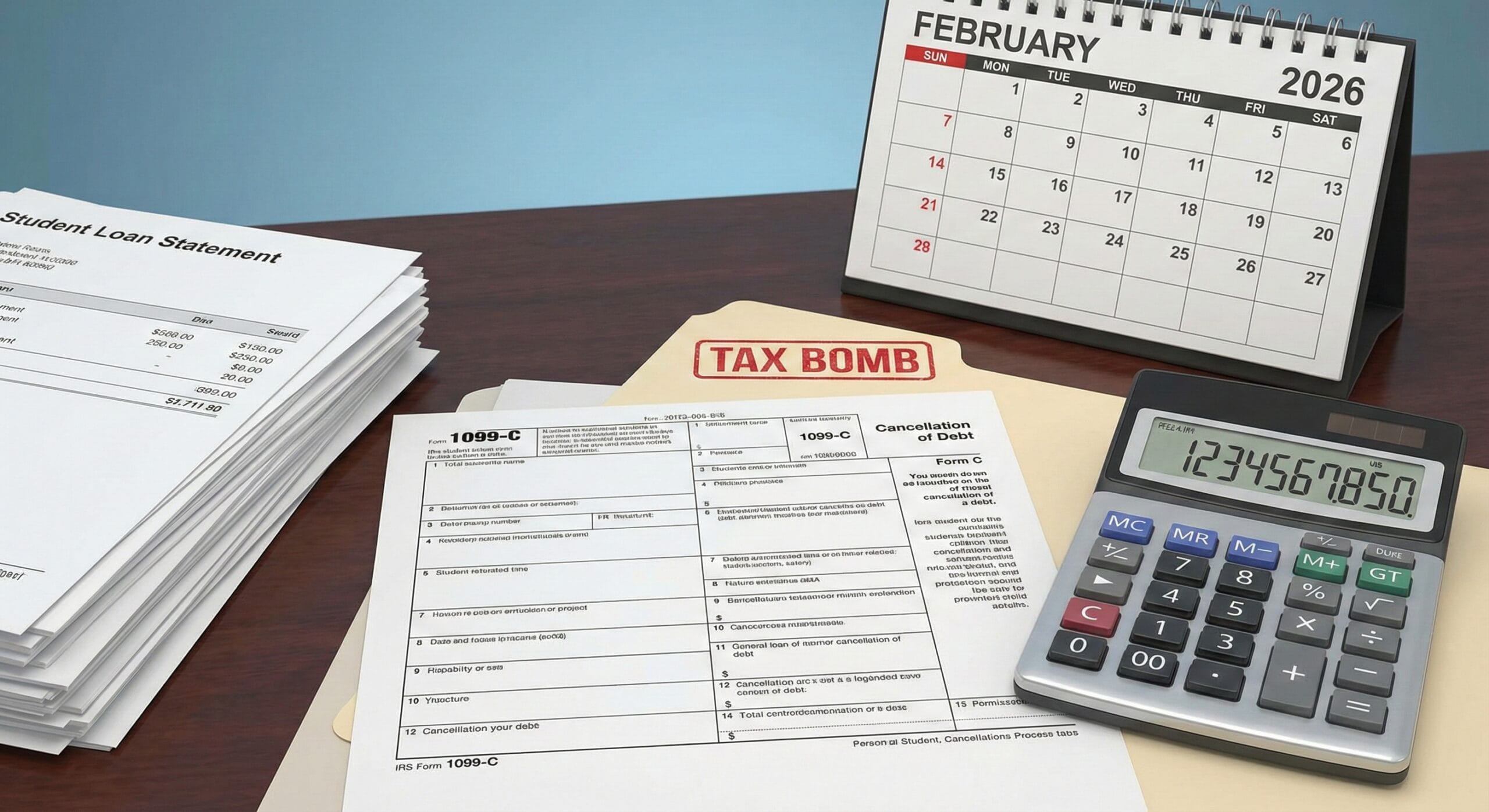
State Student Loan Tax 2026: Which States Tax Forgiveness?
While the federal government dominated the headlines for years regarding debt relief, a hidden danger has emerged in 2026: the State Student Loan Tax. For the last five years, millions of borrowers avoided tax bills because of the American Rescue Plan. However, as of January 1, 2026, the federal waiver has expired, leaving individual states to decide how they will tax your forgiven debt.
This guide explains which states are the most “dangerous” for borrowers, how private settlements trigger local taxes, and the specific steps you must take to protect your finances from a state-level tax bill.
The Great State Divide: Why Your Zip Code Matters
In 2026, your tax liability depends entirely on where you live. Some states “conform” to federal tax law, while others have their own independent tax codes. Because the federal exemption has lapsed, many states have reverted to their original rules, which view forgiven debt as taxable income.
If you live in a state with no income tax (like Texas, Florida, or Nevada), you are safe from the State Student Loan Tax. However, if you live in a taxable state, your forgiven loan could be added to your state taxable income, resulting in a surprise bill during tax season.
The “Dangerous Five”: States That Historically Tax Forgiveness
Historically, these five states have been the most aggressive in applying the State Student Loan Tax to forgiven balances:
- Indiana: Known for strict adherence to state tax codes regardless of federal waivers.
- Mississippi: Has consistently treated canceled debt as a taxable financial gain.
- North Carolina: Often requires residents to add forgiven student debt back into their taxable income.
- Wisconsin: While they have debated exemptions, they generally follow traditional tax protocols.
- Arkansas: A state where borrowers should always prepare for a local tax impact.
Note: State laws change rapidly in 2026. Always check with your local Department of Revenue for the most current exemptions.
How the State Student Loan Tax is Calculated
Unlike federal taxes, which use complex brackets, state taxes are often flatter but can still be expensive. Most states charge between 3% and 7% in income tax.
Example Calculation: If you live in a state with a 5% income tax and receive $40,000 in IDR forgiveness:
- The Bill: $40,000 x 0.05 = $2,000 due to the state. This is in addition to any federal taxes you may owe, making the total “Tax Bomb” even more devastating.
The Private Settlement Trap: A Unique State Risk
There is a second group of borrowers at risk for the State Student Loan Tax: those settling private student loans. If you negotiate a settlement with a private lender (like Sallie Mae or SoFi), they will almost always issue a Form 1099-C.
While federal law might offer certain loopholes, many state governments view private settlements as pure income. If you settle a $20,000 debt for $5,000, that $15,000 “saving” is fully taxable at the state level. This often catches borrowers by surprise because they assume settlements are “private” and not reported to state authorities.
Can You Use the Insolvency Loophole for State Taxes?
The biggest question for 2026 is: Does IRS Form 982 protect me from state taxes?. The answer is: It depends.
- Conforming States: Many states follow federal “Insolvency” rules. If you are insolvent according to the IRS, these states will also waive your state tax bill.
- Non-Conforming States: Some states do not recognize the federal insolvency exclusion. In these locations, even if you owe $0 to the IRS, you might still owe thousands to your state government.
Strategies to Defuse the State Student Loan Tax
If you are nearing forgiveness in 2026, use these strategies to minimize your state tax exposure:
- Relocation: If you are within 1-2 years of a massive forgiveness (e.g., $100,000+), moving to a state with no income tax before the forgiveness occurs could save you thousands.
- Timing Your Settlement: If you are settling a private loan, try to do it in a year where your other income is low, or you have significant state-level deductions.
- State-Level Credits: Look for specific state education credits that might offset the tax liability of the forgiven debt.
The 2026 Checklist: State Readiness
- Identify Your State’s Stance: Visit your state’s official “Department of Revenue” website and search for “Cancellation of Debt” or “Student Loan Forgiveness Taxability.”.
- Verify Your 1099-C: Ensure your state tax return matches the amount reported on your federal 1099-C.
- Consult a Local CPA: Federal tax experts may not know the specific “quirks” of your state’s tax code. Always talk to a professional who understands local laws.
Conclusion
The State Student Loan Tax is the “hidden” half of the tax bomb. While the federal government provides a framework, the ultimate cost of your forgiveness is determined in your state capital. Do not wait until April 2027 to find out you owe your state thousands of dollars. Start planning your state-level defense today.
Important: To understand how the federal IRS rules work and how to file for insolvency, read our companion guide: Federal Student Loan Tax Bomb: IRS Rules & Form 982 Guide.




Wonderful post — very practical, detailed, and easy to follow.