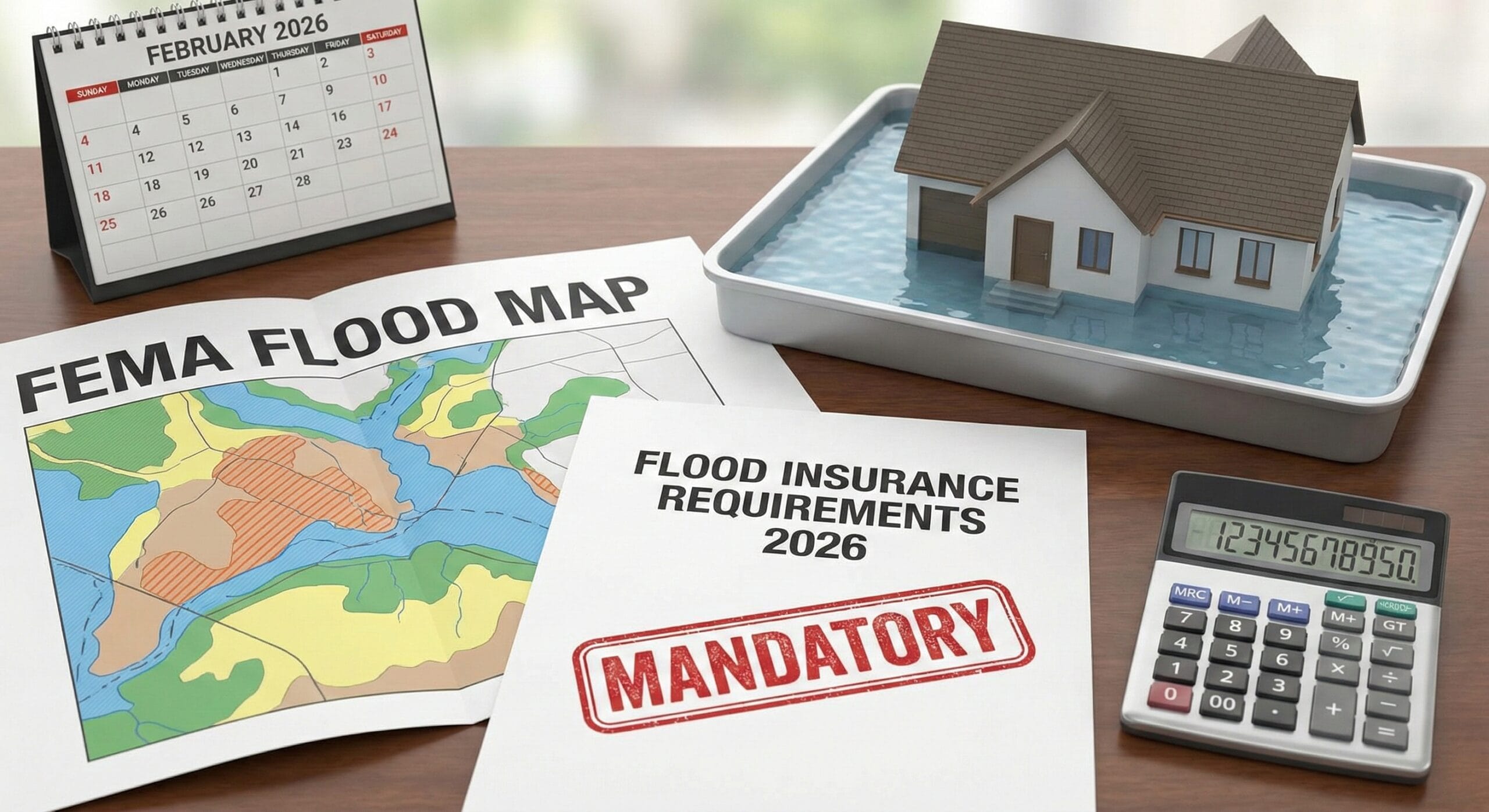
Flood Insurance Cost 2026: Mandatory Rules & Private Rates
For homeowners, the rising Flood Insurance Cost 2026 is a major financial concern. For decades, homeowners operated under a simple assumption: “If I don’t live in a flood zone, I don’t need insurance.” In 2026, that financial logic is officially dead. Between spiraling premiums and stricter federal mandates, the Flood Insurance Cost 2026 landscape has shifted dramatically.
Whether you are closing on a new FHA loan or renewing a policy in Florida, the question is no longer if you need coverage, but how much it will cost you. This guide breaks down the new mandatory purchase requirements, the price difference between private and federal policies, and the specific steps you can take to lower your premium.
When Is Flood Insurance Mandatory in 2026?
The days of optional coverage are ending for millions of Americans. In 2026, two major forces are driving mandatory purchase requirements: federal mortgage rules and state insurer mandates.
1. Federal Mortgage Borrowers (FHA, VA, USDA)
If you have a federally backed mortgage, the rules are non-negotiable. Lenders for FHA, VA, and USDA loans are legally required to verify your flood status before closing.
- High-Risk Zones (A & V): If any part of your primary structure sits in a Special Flood Hazard Area (SFHA), you must carry flood insurance for the life of the loan.
- The USDA Rule: USDA loans are particularly strict. They require coverage not just for the home, but often for attached decks or carports if they touch the flood zone.
- Lender Discretion: Even if you are in a low-risk “Zone X,” lenders now have the authority to demand coverage if they believe climate data suggests a rising risk.
2. Florida’s Citizens Insurance “Glide Path”
The most aggressive mandate in the country is happening in Florida. Citizens Property Insurance Corporation—the state’s “insurer of last resort”—is forcing policyholders to carry flood insurance to protect its own financial solvency.
- The 2026 Rule: As of January 1, 2026, if your home’s replacement cost is $400,000 or more, you must buy a separate flood policy to keep your Citizens wind coverage.
- The Future: By 2027, this requirement will extend to every single Citizens policyholder, regardless of their home’s value or flood zone.
Factors Affecting Your Flood Insurance Cost 2026
The average Flood Insurance Cost 2026 varies wildly depending on your specific risk factors under FEMA’s Risk Rating 2.0 system.
National Averages (NFIP)
While individual premiums differ, recent data gives us a baseline for what to expect:
- Zone A (High-Risk Inland): The average premium hovers around $1,750 per year.
- Zone V (High-Risk Coastal): Expect to pay significantly more, with averages often exceeding $3,000 per year due to storm surge risks.
- Zone X (Moderate Risk): These policies are cheaper but still average around $1,000 per year.
Note: These are just averages. Under Risk Rating 2.0, a home closer to a river or with a lower foundation could see premiums double these amounts.
Private Flood Insurance vs. NFIP: A Cost Comparison
One of the most effective ways to manage your Flood Insurance Cost 2026 is to shop outside the federal system. Private insurers (like Neptune, Wright Flood, or others) use different risk models than FEMA.
| Feature | FEMA (NFIP) | Private Insurance |
| Max Building Coverage | Capped at $250,000 | Can exceed $4 Million |
| Max Contents Coverage | Capped at $100,000 | Variable (often higher) |
| Additional Living Expenses | NOT Covered | Often Included (pays for hotels) |
| Waiting Period | 30 Days | 10–14 Days (or instant for closing) |
| Cost Trend | Stable but rising slowly | Volatile (can be 20% cheaper) |
Expert Tip: If your home would cost $500,000 to rebuild, an NFIP policy leaves you $250,000 underinsured. In this scenario, private insurance is not just a cost decision; it is a safety necessity.
Hidden Costs: Deductibles and Surcharges
When calculating your total Flood Insurance Cost 2026, do not forget the “hidden” fees.
- The Deductible Trap: Standard quotes often assume a high deductible (e.g., $5,000). If you lower that deductible to $1,000, your annual premium could jump by 20% or more.
- Federal Surcharges: Every NFIP policy includes mandatory fees that are separate from the risk premium, such as the Federal Policy Fee and the HFIAA Surcharge, which can add $25 to $250 to your bill.
How to Lower Your Flood Insurance Cost 2026
If your renewal quote is shocking, you have options. You can lower your Flood Insurance Cost 2026 by proving to the insurer that your home is safer than their data suggests.
- Submit an Elevation Certificate (EC): While FEMA no longer requires an EC for rating, providing one can still lower your rate if it proves your first floor is higher than the estimated Base Flood Elevation (BFE).
- Install Flood Vents: For homes with crawlspaces, installing engineered flood vents allows water to flow through the foundation rather than pushing against it. This can lead to significant premium discounts.
- Increase Your Deductible: If you have a healthy emergency fund, raising your deductible from $2,000 to $5,000 is the fastest way to slash your annual premium.
The “Waiting Period” Warning
A critical mistake homeowners make is waiting until hurricane season to buy coverage.
- NFIP Rule: There is a strict 30-day waiting period before a new federal policy takes effect. If you buy a policy on June 1st, you are not covered until July 1st.
- The Exception: The only time this wait is waived is if you are buying a policy in connection with a loan closing (buying a house).
- Private Option: Many private carriers offer a reduced waiting period of just 10 to 14 days, making them a better last-minute option.
Conclusion: Don’t Be Caught Uninsured
The Flood Insurance Cost 2026 is undeniably higher than in the past, but the cost of going without it is catastrophic. With mandatory requirements expanding in states like Florida and lenders tightening their rules for FHA and USDA loans, coverage is becoming an essential part of homeownership.
Action Plan:
- Check Your Mandate: If you have Citizens Insurance, check if your home value triggers the 2026 requirement.
- Shop Private: Get a quote from a private carrier to compare against your NFIP renewal.
- Don’t Wait: Buy your policy at least 30 days before storm season begins to avoid the waiting period trap.
Technical Deep Dive: To understand how FEMA calculates these rates using specific maps and zones, read our companion guide: FEMA Flood Insurance Rules 2026: Maps & Risk Rating 2.0



One Comment